Universal Bag Strap for Heavy Loads: What Actually Matters
A universal bag strap for heavy loads is a detachable, adjustable strap designed to replace or supplement a bag's original strap so it can carry more weight with less strain. Most shoppers focus on length and color, but for a heavy bag, the hardware and the attachment points matter just as much.
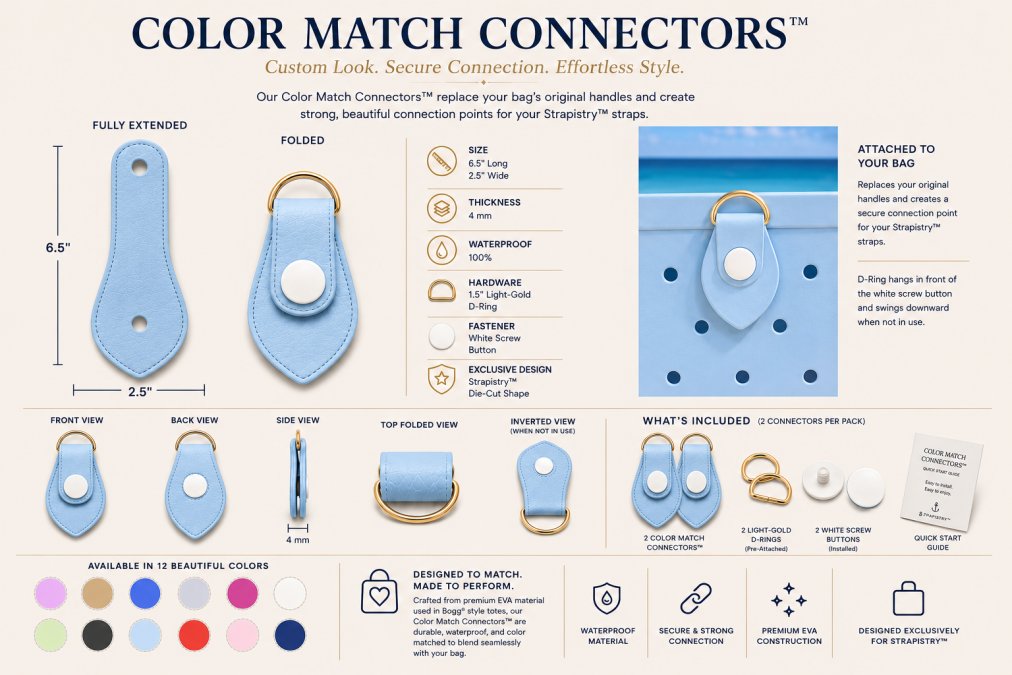
Strapistry Color Match Connectors™ give perforated totes secure attachment points with a light gold D-ring.
At Strapistry, we build modular carry systems around that exact problem: interchangeable straps, premium connectors, and attachment points designed to hold. This guide breaks down what actually determines whether a strap survives a loaded tote, a laptop bag, or a week of school runs.
Below, we cover load ratings, padding, fit, hardware, and the use cases that change which strap you should buy. The short version: treat "heavy-duty" as a set of details you can check, not a marketing word.
Quick Comparison: Heavy-Duty Bag Straps at a Glance
Bag Strap Weight Capacity: Reading Load Ratings Before You Buy
Bag strap weight capacity is the maximum load a strap is rated to carry safely, measured across the webbing, stitching, and hardware together. A strap is only as strong as its weakest component, and that is rarely the fabric.
Strapistry® Liberty Heritage Strap™ | Premium Adjustable Carry System with Signature Anchor System™
That distinction matters because capacity figures on bag strap listings often do not say how they were tested.
What most guides miss is that the failure point is almost always the connection, not the strap. Metal hooks, swivel clips, and stitched loops concentrate stress in small areas. A 2" wide polyester webbing strap can be extremely strong on its own while the clip attached to it is the part that gives way.
If you cannot find a stated rating, judge by construction instead:
Webbing width: Wider webbing spreads load across more surface area
Stitching: Look for multiple rows of stitching at stress points, not a single line
Hardware: Solid metal hooks and swivel clips hold up better than thin stamped versions
Attachment method: A connector that distributes force across a handle loop outperforms one clipped to a single thin ring
Watch OutThe most common mistake is trusting a capacity number printed on a listing without checking what it refers to. If a strap says it holds a heavy load but the swivel clips are thin stamped metal, the clips will deform long before the webbing does. Replace the hardware or choose a different strap.
Padded Shoulder Strap for Heavy Bags: Comfort That Holds Up
A padded shoulder strap for heavy bags reduces pressure on the shoulder by spreading weight across a wider surface. Padding does not reduce the load. It changes how that load meets your body.
Placement matters more than thickness: padding only helps where the strap actually rests on your shoulder.
Rubber padding and soft padding serve different purposes. Rubberized grips keep the strap from sliding off a smooth jacket or coat shoulder. Soft padding absorbs the downward pressure.
A common mistake is buying padding to solve a fit problem. If a strap digs in because it is too short and the bag rides too high, more padding just moves the discomfort.
In practice, the order of decisions is: correct length, then correct width, then padding. Strapistry straps are not padded; they rely on 2" wide woven webbing that is soft against the shoulder and spreads the load over a broader area.
Adjustable Universal Shoulder Strap: Finding the Right Length and Fit
An adjustable universal shoulder strap works when its length range covers how you actually carry the bag.
Measure before you buy. Run a tape from one attachment point, up over your shoulder, and back down to the other attachment point. Add a few inches of slack so the bag hangs where you want it.
Most adjustable straps use a sliding buckle or double adjustable buckles that let you set length from either side.
Fit considerations that matter:
Crossbody length: Needs the longest range, since the strap crosses your body diagonally
Shoulder carry: Shorter range, and where the strap rests on your shoulder matters most
Backpack conversion: Requires two straps working together, so each one needs to be independently adjustable
Layering: A winter coat adds effective body width, so leave room in the range
Check the adjustment hardware itself. A plastic slider on a heavily loaded strap can slip under load, letting the bag drop gradually as you walk. Metal or well-machined buckles hold their setting.
Crossbody Strap for Heavy Bags: Load Distribution That Reduces Strain
A crossbody strap for heavy bags distributes weight diagonally across the torso rather than concentrating it on one shoulder.
The trade-off is pressure on the opposite hip and across the chest. A wide crossbody strap reduces the digging that a narrow strap causes at the neck and shoulder.
Where crossbody carry falls short is very heavy loads over long distances. A single diagonal strap still puts all the weight on one line across your body.
This is the gap most strap advice ignores. People treat crossbody as the universal solution, then wonder why a fully loaded bag still hurts after an hour. Crossbody is a big improvement over one-shoulder carry.
If you carry the same heavy bag daily, consider a system that lets you switch between crossbody and backpack carry rather than committing to one. The Strapistry Complete Carry Kit includes three adjustable straps and six premium connectors, so you can move between crossbody, shoulder, and backpack carry without buying a new bag or changing hardware.
Strapistry™ Complete Carry Kit
Attachment Points and Hardware: What Makes a Secure Connection
Secure attachment comes down to three things: what the strap clips to, what it clips with, and how force travels through that connection.
Start with a compatibility checklist for your bag's attachment points:
Does the bag have metal D-rings, or only fabric loops?
Are the handle loops stitched closed, or open enough for a clip to pass through?
Does the bag have perforated holes, as many rubber totes and beach bags do?
Are the existing rings wide enough for your chosen hook to sit flat?
Is there a reinforced patch behind each attachment point, or just single-layer fabric?
Fabric loops that were never reinforced will stretch and tear under a heavy load, no matter how good the strap is. That is a bag limitation, not a strap limitation, and no hardware upgrade fixes it.
On the hardware side, metal hooks and swivel hooks are the two common designs. Swivel hooks rotate, which prevents the strap from twisting and keeps the webbing flat against your body.
The Strapistry Signature Anchor System uses swivel clips on both ends, which lets the strap rotate freely and stay flat rather than twisting as you move.
Pro TipWith the Complete Carry Kit, set up your connectors once and leave them on the bag. Two connectors stay on the ends for crossbody or shoulder carry, and four sit on the front and back for backpack carry. From then on, switching carry styles means clipping on a different strap, not rethreading hardware every time.
Use-Case Picks: Matching a Universal Bag Strap to Your Daily Carry
The right strap depends on what you carry and how far. A school-run tote and a commuter laptop bag have different demands, even if both are "heavy."
For parents hauling gear all day: You want wide webbing and the option to switch to backpack carry when both hands are full.
For commuters with a laptop bag or messenger bag: Prioritize attachment compatibility and hardware quality over padding. Laptop bags are heavy in a concentrated way, and a strap that twists constantly will wear at the connection points.
For travelers: Look for a detachable strap you can remove quickly at security and reattach without tools. A detachable design also lets you move one strap between a duffel bag, a briefcase, and a personal item.
For anyone with a bag collection: A modular system beats buying straps one at a time. The Strapistry Dual Carry Kit gives you two adjustable straps and four premium connectors for crossbody, shoulder, and backpack carry, and installs in under two minutes without tools or sewing.
A strap that carried a heavy load safely last month can fail next month if the stitching or hardware has degraded. A quick inspection is one of the most useful habits for anyone carrying real weight.
Check these points every few weeks:
Stitching at stress points: Look for loose threads, fraying, or pulled stitches near the clips
Webbing wear: Thinning, fuzzing, or a faded crease line where the strap bends repeatedly
Hardware: Deformed hooks, stiff swivels, or any sign the clip no longer closes fully
Buckles and sliders: Slipping adjustment under load is an early warning sign
Attachment loops on the bag: Stretched or frayed fabric loops fail before the strap does
Replace the strap at the first sign of hardware deformation or broken stitching.
Cleaning depends on material. For woven polyester webbing, spot clean with a damp cloth and mild soap, then let it air dry fully before storing.
Key TakeawayFor heavy loads, replace on condition, not on a calendar. Inspect stitching, webbing, and hardware every few weeks, and retire the strap as soon as any of the three shows damage.
Carrying heavy gear every day should not mean buying a new bag or accepting shoulder pain.
The best strap for heavy loads has three traits: a wide webbing band, a length that lets the bag sit where it should, and solid hardware. A 2" wide woven polyester strap spreads pressure across the shoulder better than a thin 1" strap, which digs in. Look for swivel clips and metal hooks that lock closed, and check the length range (24" to 50" covers most crossbody and shoulder fits). Strapistry's Liberty Heritage Strap uses 2" wide webbing with gold-tone swivel clips on both ends.
How much weight can a universal bag strap hold?
Load capacity varies by strap. The weak point is rarely the webbing. It is the stitching at the clip ends and the attachment point on your bag. Check that your bag's handle loops or holes can take the load too. For daily gear like a laptop, water bottles, and kids' supplies, a strap rated well above your actual load gives you a safety margin.
How do I know if a universal bag strap will fit my bag?
Measure the distance between your bag's attachment points and compare it to the strap's length range. A strap adjustable from 24" to 50" fits most totes, messenger bags, and duffel bags. Then check the connection: swivel clips work with D-rings, handle loops, and grommet holes. Bags with no loops or holes need a connector system that clips through existing hardware. Strapistry's Signature Anchor System clips through handle loops or straight into perforated holes, so one strap can move between your bags with handles, D-rings, or holes.
Do padded bag straps make heavy bags more comfortable?
Yes, padding reduces pressure on the shoulder, but width matters just as much. A 2" wide strap spreads weight across a larger area than a 1" strap, which concentrates force on a narrow band. Soft padding plus a wide webbing base is the combination that reduces shoulder stress on long carries. If you carry a heavy bag daily, prioritize width and fit first, then padding.
Are universal replacement straps compatible with luggage and duffel bags?
Most are, as long as the bag has attachment points the clips can reach. Duffel bags usually have D-rings or side loops, which swivel clips hook onto easily. Luggage with fixed handles may need a strap that threads through or around the existing hardware. The key is matching the clip type to the attachment point. Detachable straps with hook clips give you the most flexibility because you can move one strap between a duffel, a laptop bag, and a messenger bag without buying separate straps for each.
So easy adding the anchors. Clipped the straps and carry my Bogg bag everywhere I go, I switch from backpack to crossbody most the time. I chose the light blue stripe straps. Love them..