Will Modular Straps Damage Leather Bags? The Honest Answer
Not when they're chosen and attached with care. Modular straps are gentle on leather when the connectors suit the bag's attachment points and the load is spread correctly. Damage happens when hardware rubs bare leather, when clips sit on thin rolled handles, or when a heavy bag hangs from one narrow stress point. At Strapistry™, our modular carry system attaches through the handle loops or holes a bag already has, so compatible bags you already own can become crossbody, shoulder, or backpack styles without tools, sewing, or a new bag.
The real question is not whether modular straps damage leather. It is whether the attachment point can take the load.
Most guides skip that part. They tell you to "be careful" and stop there. Below, we break down how attachments contact leather, what to check before you clip anything on, and how to protect your bag so it lasts for years.
How Modular Strap Attachments Contact and Stress Leather
Every strap attachment creates three forces on a leather bag: pressure, friction, and pull. Pressure comes from the connector pressing against the leather. Friction comes from movement as you walk. Pull comes from the bag's weight hanging on one spot.
A leather strap that already has a stitched seam spreads that load across a wide area. A clip or slider added later concentrates the same load on a much smaller surface.
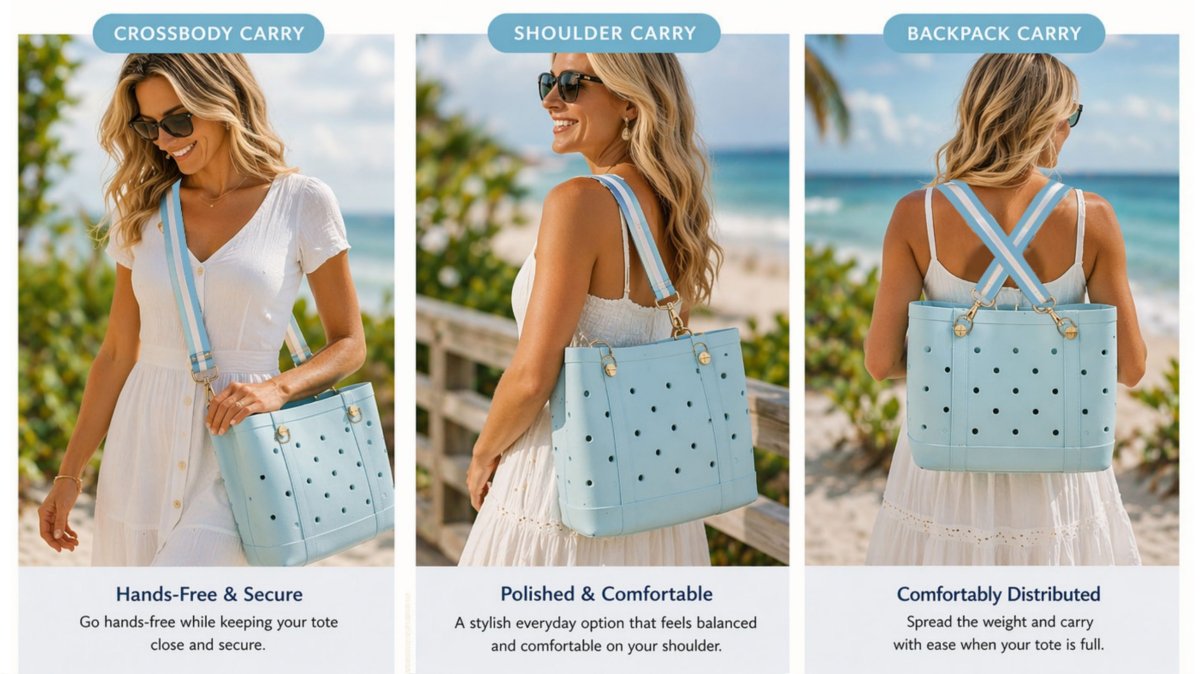
Three ways to carry: crossbody, shoulder, and backpack.
Where the connector touches matters as much as how much it weighs. Metal hardware on bare, unfinished leather will leave a mark over time. Hardware on a padded or reinforced loop usually will not.
Watch OutThe most common mistake is clipping a heavy bag onto a thin rolled handle. The handle stretches, the stitching pulls, and the leather cracks at the seam. If the handle flexes when you lift the bag, it is not built for a modular strap.
Universal Bag Strap Connectors: What to Check Before You Attach
Universal bag strap connectors are clips, sliders, or rings designed to fit more than one bag. Before you attach one, run this five-point check:
Loop thickness: Can the connector close fully around the handle or loop without squeezing it?
Loop width: Does the connector sit flat, or does it bunch the leather?
Attachment point strength: Is the loop stitched and reinforced, or just folded leather?
Hardware finish: Are the connector edges smooth, or can you feel a sharp lip?
Bag weight: Does the bag plus contents stay under what the loop was built to hold?
If any answer is no, stop. A connector that fits loosely will slide and rub. One that fits too tight will press into the leather and leave a permanent dent.
Pro TipTest the fit with the bag empty first. Load it, lift it, and watch the attachment point. If the loop twists or the leather creases sharply, the connector is wrong for that bag, no matter how good it looks.
How to Attach a Strap to a Bag Without Loops
A bag without loops is not a dead end. You have three safe options, and one to avoid. What most guides skip is the actual sequence, how to install and remove a modular strap so you never twist, scrape, pinch, or overload the leather. Here is the method.
The safest route is a connector that clamps onto an existing seam or a reinforced edge. The second option is a strap that wraps around the bag body and spreads the load across a wide band. The third is a small D-ring added by a leather worker, which gives you a proper attachment point.
What you should not do is clip hardware directly onto a soft, unsupported panel. That panel will stretch and tear under load.
Safe installation, step by step
Empty the bag. Attach hardware with the bag unloaded so you can see how the leather sits without weight distorting it.
Identify the load-bearing element. Look for a stitched seam, a reinforced edge, or a factory D-ring. If the only option is a single layer of folded leather, stop and choose a different method.
Check orientation before clipping. The connector should sit flat against the leather with its gate or opening facing away from the bag body. A clip rotated sideways presses its edge into the surface.
Open the connector fully. Never force a clip over a loop. If it does not close with light pressure, the loop is too thick for that connector.
Seat the connector, then close it. Let it rest in position first, then snap or screw it shut. Closing first and sliding it into place is what scrapes the finish.
Load gradually. Add a light load, lift the bag, and watch the attachment point. If the loop twists, creases sharply, or the connector shifts, remove it and reassess.
Safe removal
Reverse the sequence. Unload the bag first, then open the connector fully before lifting it away. Pulling a closed clip off a loop is the single most common cause of surface scuffs and stretched stitching. If the connector has a screw gate, back it out completely rather than prying it open.
Strapistry's modular carry system was designed with this kind of care in mind. Our Signature Gold Connectors™ are solid brass with a light-gold finish, and our Color Match Connectors™ come in shades chosen to coordinate with each Strapistry™ strap. Both attach without tools and without punching holes in your bag. They need a handle loop or an existing hole to attach to, so a bag with neither isn't a fit for Strapistry connectors.
Bag type
Best attachment method
Watch out for
Tote with stitched loops
Clip connector onto the loop
Loop width and stitching strength
Bag with no loops
Wrap-around strap or added D-ring
Soft panels that stretch
Crossbody with existing hardware
Swap the strap, keep the rings
Ring finish and wear
Structured leather purse
Connector on reinforced seam
Sharp edges on the connector
How to Prevent Leather Bag Strap Wear at Attachment Points
Prevention comes down to four habits, and none of them take more than a minute. But habits only go so far, the materials you put between hardware and leather, and the finish on your bag, decide how much protection you actually need.
Rotate your attachment points. If you always clip in the same spot, that spot wears first. Move the connector slightly when you can.
Keep hardware clean. Grit trapped between metal and leather acts like sandpaper. Wipe connectors with a soft cloth.
Condition the leather. A leather conditioner keeps the surface flexible. Dry leather cracks faster under pressure.
Match the strap to the load. A wide, padded strap spreads weight better than a thin cord. That reduces pull at the attachment point and eases your shoulder at the same time.
Protective materials that actually help
A barrier between hardware and leather is the most direct fix. Most practitioners find these work well, in rough order of protection:
Soft leather or felt sleeves that slide over the connector. They cushion pressure and stop metal-on-leather contact entirely.
Fabric barriers such as a thin strip of suede or canvas folded under the connector. Cheap, replaceable, and effective on smooth finishes.
Leather-safe padding on the inside of a loop, which spreads load without adding bulk.
Hardware covers for clips that sit against a visible panel, useful on coated and patent finishes where scuffs show most.
Two cautions. Avoid adhesives that are not labeled leather-safe, many leave a residue or lift the finish when removed. And test any dyed fabric or padding on a hidden area first, because color transfer onto light leather is difficult to reverse.
Match protection to the finish
The right barrier depends on what your bag is made of:
Smooth and full-grain leather: Tolerates bare hardware better than most, but still benefits from a sleeve on high-contact clips.
Coated and patent finishes: The coating scuffs and peels where hardware rubs. Use smooth-edged connectors and a cover.
Suede and nubuck: Open-pored and quick to mark. Keep hardware still and use a fabric barrier rather than metal against the surface.
Delicate or bonded leather: Thin and prone to tearing at stress points. Padding plus a wide, light strap is the safer combination.
Key TakeawayStrap wear is not caused by modular straps. It is caused by concentrated load on an unprepared attachment point. Spread the load, add a barrier where metal meets leather, and the leather holds up.
Damage Risk by Leather Type and Finish
Not all leather takes stress the same way. The finish on top often decides how a bag ages.
Full-grain leather: Strongest and most forgiving. It develops a patina rather than cracking.
Top-grain leather: Durable, but the surface can peel if it rubs against hard metal.
Bonded leather: Made from leather fibers. It tears at stress points and is a poor match for heavy loads.
Patent or coated finishes: The coating scuffs and peels where hardware rubs. Use smooth-edged connectors only.
Suede and nubuck: Soft and open-pored. Friction marks show fast, so keep hardware still.
The pattern is simple. The more natural and thick the leather, the more it tolerates a modular strap. The more processed and thin the surface, the more care the attachment point needs.
Can Leather Purse Straps Be Repaired? Fixes and Early Warning Signs
Yes, leather purse straps can be repaired in most cases, and catching the damage early keeps the fix cheap and simple.
Watch for these early signs:
Fraying at the stitched seam
A soft or stretched loop
Fine cracks along the fold
Peeling on a coated finish
A connector that suddenly fits looser than before
Small cracks and fraying can often be treated with a leather conditioner and a flexible patch on the inside of the strap. Torn straps usually need a leather worker to restitch or replace the section. If the attachment loop itself has failed, that is a repair job, not a DIY one.
That is the point of a modular system: the bag you love stays, and only the way you carry it changes.
Conclusion: Carrying Your Bag with Confidence
The fear that modular straps will ruin a good leather bag comes from one real risk: load concentrated on a weak point. Fix the attachment, and the risk mostly disappears. Check your loops, match the connector to the leather, and spread the weight.
Strapistry exists for exactly this. Our modular carry system turns compatible bags you already own, those with handles or holes, into crossbody, shoulder, or backpack styles, with a patent-pending design, interchangeable straps, and connectors that attach without tools. You keep the bag you love and change how you carry it.
Shop Carry Kits and give your favorite bag a second life.
Frequently Asked Questions
Can modular straps damage leather bags?
Modular straps can damage leather if the hardware is rough, the connector is too tight, or the attachment point is already weak. Smooth, polished connectors that spread load across a wider surface reduce friction and pressure. The real risk comes from metal edges grinding against leather over time, so inspect connectors for burrs and check that your bag's attachment points can handle the strap's weight before installing.
How do I attach a crossbody strap without damaging a leather bag?
Match the connector width to your bag's loop or hardware, then slide it on without forcing. Avoid overloading the strap with heavy contents that pull hard on a single point. If your bag has no loops, use a connector that wraps around the handle base rather than clipping to a thin strap. Remove the strap when storing the bag to prevent prolonged pressure marks on the leather.
Can leather purse straps be repaired?
Many leather purse straps can be repaired, especially if the damage is cracking, fraying, or a torn stitch rather than a full break. A leather specialist can reinforce the strap with stitching, add a flexible patch, or replace the damaged section. For minor wear, conditioning the leather and reinforcing stress points early can extend the strap's life. Severe breakage at the attachment point may need professional reconstruction.
Are universal bag strap connectors safe for bags without dedicated strap loops?
Universal connectors work on bags without loops if they wrap around a structural part of the bag, such as the handle base or a reinforced seam. The key is load distribution: a connector that grips a wide, sturdy area causes less stress than one clipped to a thin edge. Test with light contents first, check for slipping, and avoid attaching to decorative trim that is not built to carry weight.
So easy adding the anchors. Clipped the straps and carry my Bogg bag everywhere I go, I switch from backpack to crossbody most the time. I chose the light blue stripe straps. Love them..